
For homeowners on the Mornington Peninsula, a flooring renovation is a significant investment that is uniquely threatened by the local environment. This guide is designed to move beyond aesthetics, providing you with the technical “insider” knowledge required to protect your home from the common coastal pitfalls that lead to floor failure.
The Mornington Peninsula offers one of the most beautiful coastal lifestyles in Victoria, but it presents a unique set of challenges for homeowners. From the salt-sprayed cliffs of Sorrento to the reactive clay soils of Mount Martha and Frankston, the local environment is notoriously tough on interior finishes. When it comes to flooring, the stakes are high: most failures occur 4–6 months after installation, when seasonal changes expose poor preparation.
To ensure your investment stands the test of time, this guide explores the essential installation strategies and material trends tailored for the Peninsula’s microclimate in 2026.
TL;DR: Essential Flooring Tips at a Glance
- Test Moisture Early: Concrete must be <75% RH for timber installations to prevent buckling.
- Acclimatize Everything: Allow 7 days for solid timber and 48 hours for hybrid to reach equilibrium with your home’s air.
- Use the Right Glue: Moisture-cure urethane is essential for coastal humidity; never settle for cheap acrylic alternatives.
- Mind the Gaps: Maintain 10–15mm expansion gaps around all perimeters to allow for natural wood movement.
- Time it Right: April–May or September–October offer the most stable installation conditions.

Standard installation methods often fail here because they don’t account for three primary environmental factors unique to our region.
1. Extreme Humidity Fluctuations
Peninsula homes experience humidity swings from 35–45% in winter to 75–85% in summer. This 40-point range causes timber to expand or contract up to 2–3mm per meter of width. Products tested in controlled labs behave differently in our real-world coastal environment.
2. Clay Soil Movement
Soil across Mount Martha, Mornington, Mount Eliza, and Frankston consists of reactive clay. It expands when wet and contracts when dry, causing vertical movement of 10–40mm in concrete slabs. This shifting can affect floor levelness and increase moisture transmission through micro-cracks in the slab.
3. Salt Air and UV Exposure
If you live within 2km of the coast, your floors face accelerated wear from salt deposits and increased UV exposure from reflected ocean light. These factors demand specific product selection to ensure long-term performance.
Critical Pre-Installation Requirements
For a homeowner, success is determined before the first plank is laid. Skipping these steps accounts for the high failure rate seen in local DIY projects.
Moisture Testing is Non-Negotiable
Every installation should begin with professional moisture testing. Concrete slabs—especially in homes built before 2000—often contain moisture levels far above acceptable thresholds.
- Solid Timber: Concrete must be below 75% relative humidity.
- Engineered Timber: Requires less than 5.5% moisture content for glue-down setups.
- Hybrid Flooring: Can tolerate up to 95% RH, but testing is still recommended for safety.
Subfloor Preparation
The levelness of your subfloor determines how your floor feels underfoot and its long-term success.
- Concrete: Surface must be within ±3mm per 3-meter span for timber installations.
- Timber Subfloors: Homes built between 1950 and 1990 often have frames that show bounce or unevenness after decades of coastal weather. A 12mm structural plywood overlay is often required, but only after a mandatory termite inspection.
Material Acclimatization
Flooring arrives from warehouses at a different moisture content than your home. To prevent “shocking” the material, it must reach equilibrium in the room where it will be installed.
- Solid Timber: 7 days (168 hours) with your heating/cooling running.
- Engineered Timber: 5–7 days in the installation room.
- Hybrid Flooring: 48 hours minimum.
Material Comparisons for the Peninsula
The Rise of Wide Planks and Matte Finishes
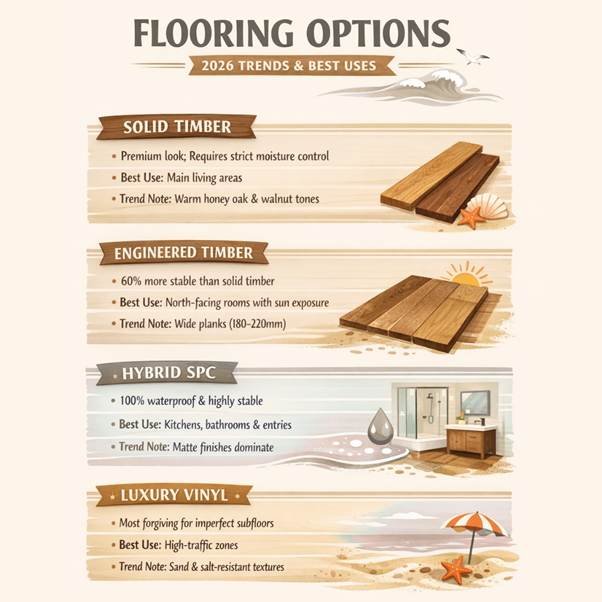
In 2026, the trend has shifted toward wide planks (180–220mm), which create a cleaner, contemporary look in open-plan layouts. Additionally, matte finishes (10–30 gloss units) are replacing high-gloss options. For Peninsula homeowners, matte is practical: it reduces glare from the sun reflecting off the water and hides sand and salt deposits better than shiny surfaces.
Professional Installation: The Homeowner’s Safeguard
Adhesive: The “Gold Standard”
Your choice of adhesive is critical. Moisture-cure urethane adhesive is the only recommendation for timber in coastal areas. While it is more expensive than acrylic, it provides the 300–400% elongation needed to accommodate timber movement without the bond failing.
Expansion Gaps
Every floor moves with temperature and humidity. Without perimeter gaps, expansion forces cause buckling or cupping.
- Solid/Engineered Timber: 10–15mm perimeter gaps.
- Hybrid Flooring: 5–8mm perimeter gaps.
Seasonal Timing
The “shoulder seasons”—April to May or September to October—are the optimal windows for installation. During these months, humidity sits closer to the annual average, minimizing extreme seasonal gaps or buckling later in the year.
Essential Peninsula Flooring FAQs
How long before I can move furniture back?
- Glue-down timber: Wait 72 hours minimum for light furniture and 7 days for heavy items.
- Floating systems: Requires 24 hours for light items and 48 hours for heavy items.
- Area rugs: Wait 14 days to allow for complete adhesive curing and off-gassing.
What causes my timber floors to “cup”?
The primary cause is moisture exposure from below due to inadequate moisture barriers. Prevention requires proper moisture testing and barrier installation before flooring goes down.
Can I install over existing tiles?
Yes, if they are firmly bonded and within levelness tolerance. We recommend a 6mm cement board overlay to provide a smooth surface and additional moisture barrier.
Conclusion: Investing in Quality
Successful flooring on the Mornington Peninsula isn’t just about what looks good in a showroom; it’s about choosing products and installation methods that are built to last in real coastal conditions. That’s why many homeowners trust Flooring Gallery Frankston — because the focus isn’t only on style, but on moisture testing, proper acclimatization, and expert installation done right the first time. By prioritising these critical steps with the guidance of Flooring Gallery Frankston, you protect your investment and ensure your home value is enhanced for years to come.


